
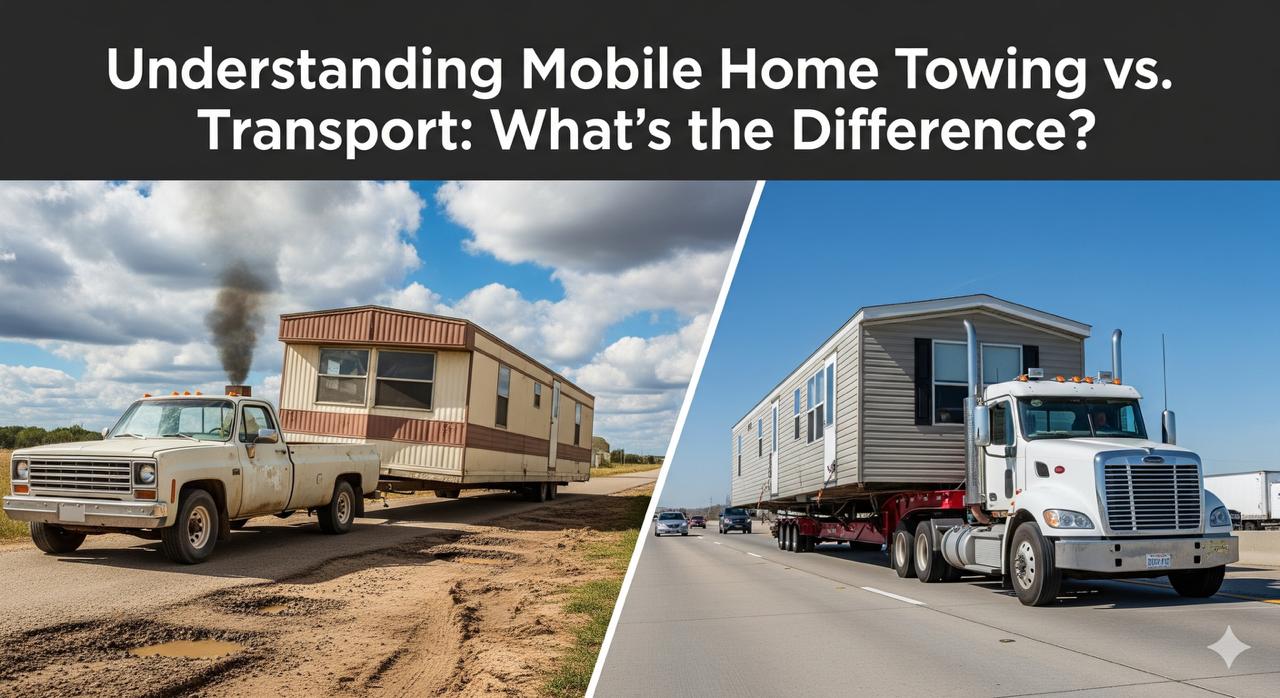
People often search for “mobile home towing” when they need to move a manufactured home. It’s an easy assumption: a mobile home has wheels, so surely a tow truck can pull it. In practice, moving a mobile home is a regulated transport job that needs special trucks, permits, escorts and a proper setup at the new site. This guide explains the difference between towing and professional transport, and why it matters for your home and your wallet.
Why People Think Mobile Homes Can Be Towed
A manufactured home is built on a steel chassis with a hitch at the front, and it travels on its own axles and tires. So in one sense, every mobile home move involves pulling the home behind a truck. The difference is in what pulls it, who is driving and everything that happens before and after the drive.
What “Towing” Usually Means
When someone offers to tow a mobile home, they usually mean hitching it to a pickup, a farm truck or a standard tow truck and pulling it to the new spot. That approach has serious problems:
- The wrong truck. Pickups and tow trucks aren’t built to control a load this long, wide and heavy, especially on hills, turns and in wind.
- No permits. A mobile home is an oversize load. Moving it on public roads without a permit can lead to fines, impoundment or an order to stop.
- No escorts. Wider homes often require pilot cars, which a tow operator rarely provides.
- No teardown or setup. Someone still has to disconnect and prepare the home, then block, level, anchor and reconnect it at the other end.
- Insurance gaps. Many tow and general haulers aren’t insured to move homes. If the home is damaged, you may carry the cost.
What Professional Mobile Home Transport Includes
Professional transport is a complete service built around moving homes. It includes:
- Toter trucks. Heavy trucks made to pull manufactured homes, with the power, brakes and hitch to control the load.
- Running gear. Axles, brakes and tires checked or fitted so the chassis can travel safely.
- Permits and route planning for every state on the way, avoiding low bridges, narrow roads and restricted hours.
- Pilot cars or police escorts where the permit requires them.
- Teardown: skirting, steps and porches removed, utilities disconnected and anchors released.
- Splitting and sealing for double-wides and larger homes.
- Setup by licensed installers: blocking, leveling, anchoring to your wind zone, rejoining sections and reconnecting utilities.
- Insurance that covers the home while it’s in the mover’s care.
Towing vs. Transport at a Glance
| Towing | Professional transport | |
|---|---|---|
| Truck | Pickup or standard tow truck | Toter truck built for homes |
| Permits | Rarely obtained | Obtained for every state |
| Escorts | Rarely provided | Provided where required |
| Teardown | Usually your job | Included |
| Double-wides | Not practical | Split, moved and rejoined |
| Setup | Not included | Licensed installation |
| Insurance | Often none for this work | Covers the home in transit |
| Distance | Very short moves only | Local and long-distance |
What Can Go Wrong With a Tow Job
- Frame and wall damage. Poor hitching, bad tires or sudden braking can twist the frame and crack walls.
- Blown tires and axles. Old running gear that hasn’t been checked can fail on the road.
- Roadside stops. Without permits, the move can be halted, leaving your home on the shoulder.
- Accidents. A wide load without escorts is a hazard to other drivers, and you may share the liability.
- An unfinished home. A home dropped on a lot without setup can’t pass inspection or be lived in safely.
Cost: Is Towing Really Cheaper?
A tow quote can look cheap because it only covers the drive. By the time you add permits, escorts, teardown, a licensed installer and the risk of uninsured damage, the savings usually disappear. Most of our professional moves cost $2,000 to $15,000 for the whole job, depending on home size, distance, permits and escorts, site access and setup. See what a complete quote should include in our mobile home moving cost guide.
Is Towing Ever OK?
Moving a home a short distance on private land, such as across your own property, may not need road permits. Even then, the home needs proper teardown and setup, the running gear must be safe and the person moving it should be insured. If the home will touch a public road, treat it as a transport job.
How to Hire the Right Mover
- Ask what truck they use. You want a toter truck, not a pickup or wrecker.
- Ask who gets the permits and whether escorts are included.
- Confirm insurance and any license your state requires.
- Check that setup is included and done by licensed installers.
- Get a written quote that lists each part of the job.
Read how to choose a licensed mobile home mover and transport companies vs. local haulers for more.
Running Gear: The Part Most People Forget
A manufactured home travels on its own axles, brakes and tires, called running gear. After the home is set up, the running gear is often removed and sold or returned, and the hitch may be taken off too. That means many homes have no road-ready wheels by the time they need to move again.
A professional mover checks the running gear before the trip and fits safe axles and tires if needed. They check:
- Axles and hubs for rust, bent spindles and worn bearings.
- Tires for age, load rating and condition. Old tires can fail even if they look fine.
- Brakes, which many states require on some or all axles.
- The hitch, which must be secure and rated for the load.
- Lights and markings required for an oversize load.
Skipping these checks is a common cause of breakdowns on the road during a mobile home move.
What Happens on the Road
A professional transport follows the permit to the letter. The route is set in advance to avoid low bridges and tight turns. Many states only allow oversize loads during daylight and on weekdays. Pilot cars ride ahead to warn traffic and check clearances, and sometimes behind to protect the load. The driver makes regular checks of tires, hubs and straps along the way. On long moves the home stops overnight at safe locations.
Signs You’re Talking to a Tow Operator, Not a Mover
- They quote a price over the phone without asking about the home’s size, age or both sites.
- They don’t mention permits, escorts or route planning.
- They plan to use a pickup, wrecker or flatbed.
- They can’t say what happens to the home after it’s dropped off.
- They don’t have insurance that covers the home itself.
Any one of these is a reason to keep looking. A real mobile home mover asks questions first, visits or reviews photos of the home, and puts the full job in writing.
Short Moves Still Need Professionals
Many people reach for a tow truck because the move is short, sometimes just a few miles. But a short trip still involves the same teardown, permits on public roads and setup at the other end. The drive is often the quickest part of the job.
Frequently Asked Questions
Can I tow a mobile home with a pickup truck?
We don’t recommend it. Most pickups aren’t built to control a load this size, and moving a mobile home on public roads still needs permits and, often, escorts.
Is it legal to tow my own mobile home?
Rules vary by state, but any move on public roads needs an oversize-load permit, and many states have rules about who can transport and install manufactured homes. Check before you try.
What is a toter truck?
A heavy truck designed to pull manufactured homes, with the power, braking and hitch needed to control a long, wide load safely.
Does transport include setting up the home?
With a full-service mover, yes. Our crews handle teardown, permits, transport and setup.
Why do some mobile homes have no wheels?
Axles and tires are often removed after setup and sold or returned. Your mover can supply road-ready running gear for the trip.
How much does it cost to move a mobile home professionally?
Most of our moves cost $2,000 to $15,000 for the whole job, including teardown, permits, transport and setup. The final price depends on home size, distance, permits and escorts, site access and setup work.
Can a flatbed truck move a mobile home?
Manufactured homes travel on their own chassis, so they’re pulled rather than loaded onto a flatbed. Modular sections, which have no chassis, are carried on trailers.
Move Your Home the Right Way
Tell us about your home through our free quote form and we’ll send a written quote for the whole job. See our mobile home moving services, or plan ahead with our mobile home moving checklist.
Planning a mobile home move?
Tell us about your home and where it’s going. We’ll reply with a full price for the whole job, permits and setup included.