
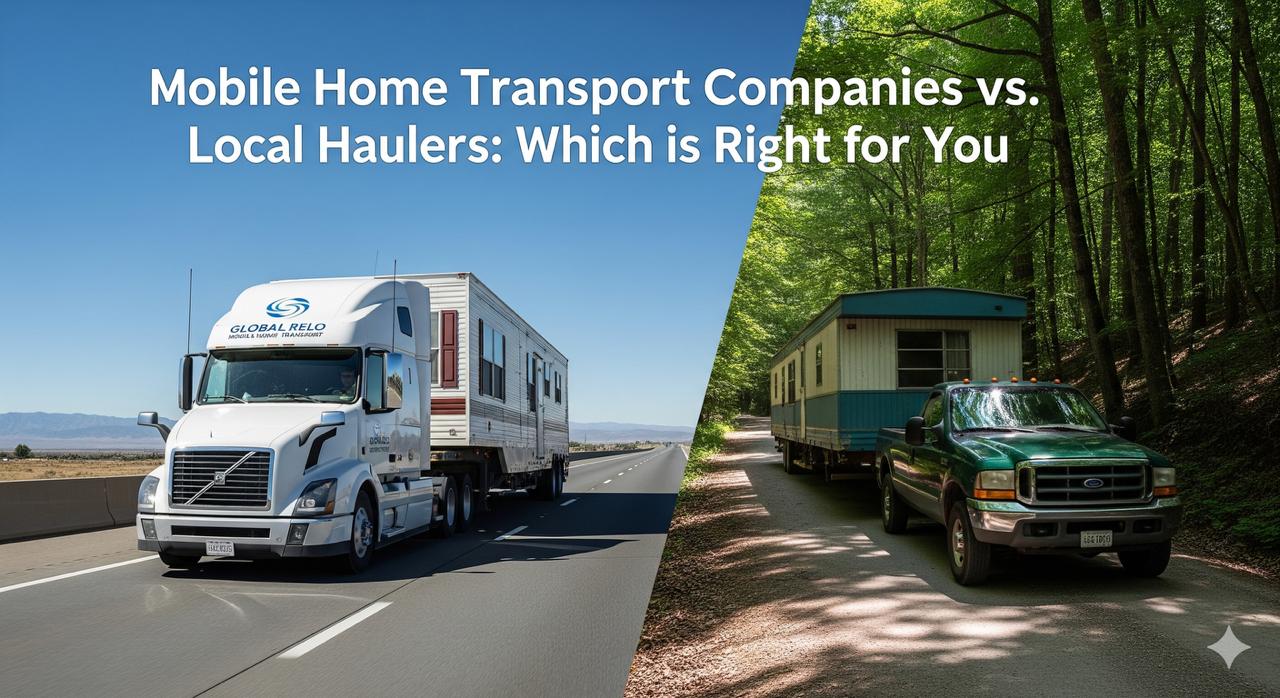
Search for someone to move your mobile home and you’ll find two kinds of results: mobile home transport companies and local haulers. Both can pull a home down the road, but what they include, what they’re responsible for and what you end up paying can be very different. This guide compares the two side by side so you can choose the right one for your move.
What Is a Mobile Home Transport Company?
A mobile home transport company specializes in moving manufactured and mobile homes. The best ones are full-service: they plan the move, handle the paperwork, tear the home down, haul it and set it back up. A typical full-service company provides:
- Permits and route planning for every state on the way.
- Pilot cars or police escorts where the permit calls for them.
- Teardown: skirting, steps and porches removed, utilities disconnected, anchors released.
- Splitting and sealing for double-wide and larger homes.
- Toter trucks and running gear, including axles and tires if the home needs them.
- Setup by licensed installers: blocking, leveling, anchoring, rejoining sections and reconnecting utilities.
- Insurance that covers the home during the move.
What Is a Local Mobile Home Hauler?
A local hauler is usually a small or independent operator with a truck that can pull a mobile home. Some are experienced and reliable; others are general haulers who move homes now and then. Typically, a local hauler:
- Moves homes short distances, often within one county.
- Provides transport only, sometimes with basic teardown.
- Leaves permits, escorts and setup for you to arrange.
- May or may not carry insurance or the registration needed for the work.
- Charges less up front because the quote covers less.
Side-by-Side Comparison
| Transport company (full-service) | Local hauler | |
|---|---|---|
| Permits | Gets them for you | Often your job |
| Escorts | Arranged | Often your job |
| Teardown | Included | Sometimes |
| Transport | Local and long-distance | Mostly short local moves |
| Double-wides | Split, sealed and rejoined | Varies; often transport only |
| Setup | Licensed installers | Usually not included |
| Insurance | Covers the home in transit | Varies; ask for proof |
| Price on the quote | Higher, but covers the whole job | Lower, but covers less |
| Who’s responsible | One company for everything | You coordinate several people |
What Each Option Really Costs
Most of our full-service moves cost $2,000 to $15,000 for the whole job, depending on home size, distance, permits and escorts, site access and setup. A local hauler’s quote may look lower, but it often leaves out:
- Permit fees and the time to apply for them.
- Pilot cars for wider homes.
- A licensed installer to block, level, anchor and rejoin the home.
- Utility reconnection and skirting.
- Insurance if something goes wrong on the road.
Once those are added, the gap often shrinks or disappears. Compare quotes against the checklist in our mobile home moving cost guide so you’re comparing the same work.
When a Transport Company Is the Better Choice
- You’re moving more than a short distance, or across state lines.
- Your home is a double-wide, triple-wide or modular home.
- You want setup done by licensed installers so the home passes inspection.
- Your lender, insurer or park requires a licensed, insured mover.
- You’d rather have one company responsible for the whole result.
When a Local Hauler Might Work
- The move is short and simple, such as a single-wide across one property or to a nearby lot.
- You’ve already arranged permits and a licensed installer yourself.
- The hauler can show proof of insurance and any registration your state requires.
- You’re comfortable coordinating the teardown, move and setup between different people.
Even then, get everything in writing and confirm who is responsible for damage during transport.
Risks of Going Cheap
- Fines and delays if the home is stopped without the right permits.
- Damage without coverage if the hauler isn’t insured.
- A home you can’t live in if nobody is lined up to set it up.
- Leaks and structural problems if a double-wide is rejoined poorly.
- Failed inspections if anchoring doesn’t meet local wind-zone rules.
The same risks apply, even more so, to anyone offering to simply “tow” the home. Read mobile home towing vs. transport.
How to Choose
- Get at least two complete quotes that list teardown, permits, escorts, transport and setup.
- Ask for proof of insurance and any license or registration that applies.
- Ask who does the setup and whether they’re licensed in the state where the home is going.
- Read reviews that mention what happened after the home arrived.
- Compare the total cost, not the first number on the page.
Our guide on how to choose a licensed mobile home mover has a full list of questions to ask.
Three Common Scenarios
A single-wide moving a few miles
The home is going from a park to family land in the same county. A local hauler could pull it, but someone still needs a road permit, a licensed installer to block, level and anchor it, and possibly a county inspection. A full-service company handles all of this in one quote, which is often simpler for little or no extra cost.
A double-wide moving across the state
This needs two loads, two permits, escorts and a careful reassembly. A transport company with its own setup crews is the clear choice. A hauler without reassembly experience puts the home at real risk of leaks and gaps.
Any home moving out of state
Permits for several states, interstate carrier registration, travel-time rules and installation rules in the new state all apply. Choose a company that moves homes across state lines regularly.
Questions to Ask a Local Hauler
If you’re still considering a hauler, ask these before you agree to anything:
- Can you show proof of insurance that covers my home while you move it?
- Who gets the permits, and are they included in your price?
- What truck will pull the home?
- Do you supply axles and tires if mine are missing or worn?
- Who will set up the home, and are they licensed?
- What happens if my home is damaged?
If the answers are vague, treat that as your answer.
What You’re Really Paying For
The price of moving a mobile home isn’t just the drive. It pays for the planning that keeps the move legal, the equipment that keeps the home safe on the road, the skills to put it back together properly, and the insurance that protects you if something goes wrong. A transport company bundles all of these into one price. A hauler’s price usually covers only the truck and driver, and the rest is up to you.
When you compare, ask one simple question of every quote: “When you leave, will my home be ready to live in?” If the answer is no, add the cost of everything still left to do before you decide which option is cheaper.
Insurance: The Detail That Matters Most
Your homeowner’s policy may not cover the home while it’s on the road. That makes the mover’s insurance your main protection during transport. Ask for a certificate of insurance, check that it names the company you’re hiring, and ask what the coverage limit is and what it excludes. A reputable transport company provides this without fuss. If a hauler can’t, the savings aren’t worth the risk.
Frequently Asked Questions
Are local haulers cheaper?
Their quotes are often lower, but they usually cover less. Once you add permits, escorts, setup and insurance, a full-service company is often similar in total cost.
Can a local hauler move a double-wide?
Some can haul the sections, but splitting, sealing and rejoining a double-wide takes specialist work. Make sure someone qualified is handling the reassembly.
Do I need a transport company for a short move?
Not always, but you still need permits for public roads and a proper setup. A full-service company handles both, even for short moves.
What should a mobile home transport company include?
Permits, escorts, teardown, transport, setup and insurance. If any are missing from a quote, ask whether they’re extra.
Do transport companies move homes long distances?
Yes. Full-service companies move homes within a state and across state lines, getting permits for every state on the route.
Who is responsible if a hauler damages my home?
That depends on the hauler’s insurance and your contract. If the hauler has no insurance covering your home, you may have to pursue the cost yourself. Always get proof of coverage before the move.
Can I hire a hauler and a separate installer?
Yes, but you’ll coordinate two schedules and two contracts, and it can be hard to tell who caused a problem. One full-service company avoids that.
Get a Full-Service Quote
Our own crews handle permits, transport and setup, so one company is responsible for the whole job. Tell us about your move through our free quote form or see our mobile home moving services. Planning ahead? Start with our mobile home moving checklist.
Planning a mobile home move?
Tell us about your home and where it’s going. We’ll reply with a full price for the whole job, permits and setup included.